Generally chemical synthesis involves putting a variety of compounds together in an environment where they will react and self-assemble into the desired product. You could also imagine simply putting the atoms in the right place: direct mechanical manipulation. This mechanosynthesis is however not that simple, despite the deceptive appearance of those ball-and-stick representations in high school chemistry class.
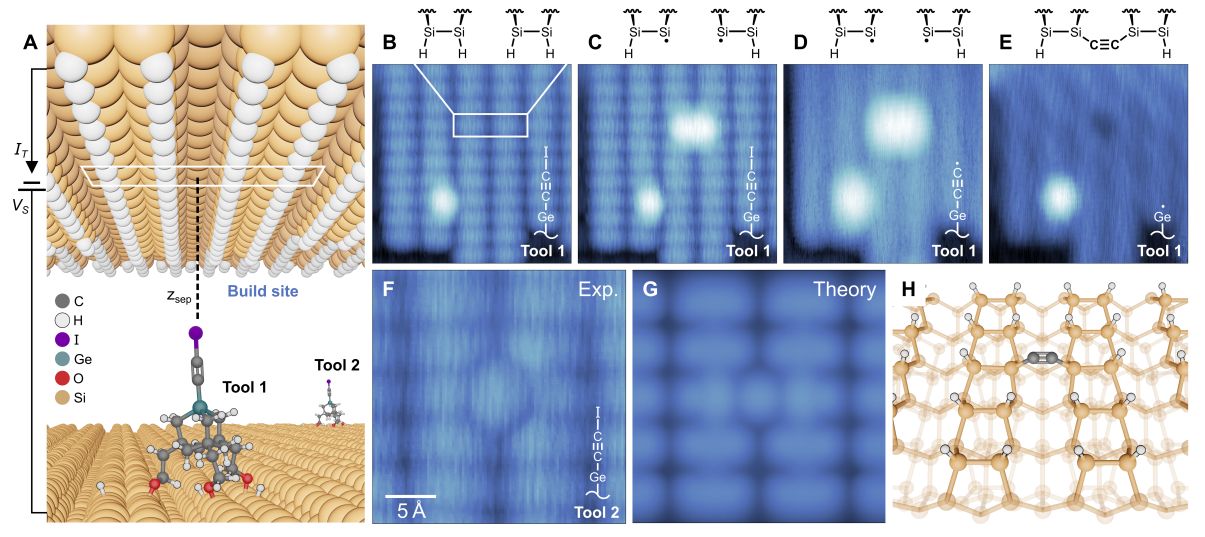
This is demonstrated in a recent (pre-publication) study by [Megan Cowie] et al. using inverted-mode STM. Using a scanning tunneling microscope (STM) you can measure a surface on a nanoscale, with the inversed principle used in inverted-mode STM (IM-STM) to physically move individual molecules. In the paper the construction of carbon-based 3D structures using IM-STM is demonstrated.
In the paper it is demonstrated how C2 units can be moved using the tip of an IM-STM setup for subsequent polyyne structure construction through C-C bond formation at the target site. Although it’s not quite yet the leap into Neal Stephenson’s The Diamond Age with its science-based matter compilers – i.e. molecular assemblers – it’s definitely another step closer to making advanced feats of nanotechnology a part of every day life.